When Law Meets Power: Trump’s Push Towards Dictatorship
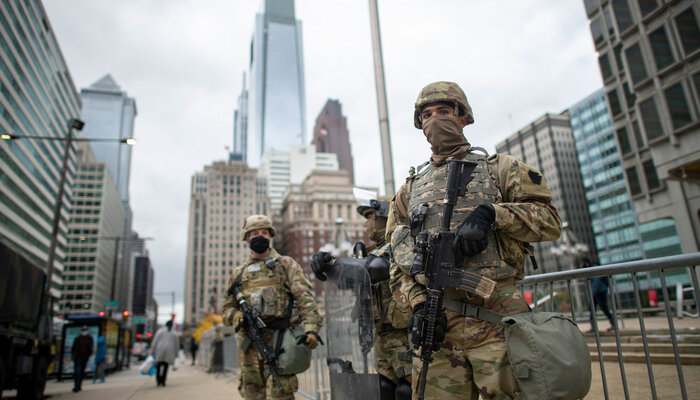
In recent months, talk has intensified around President Trump’s potential use of the Insurrection Act. The Insurrection Act is a centuries-old law that allows the president to deploy U.S. military forces, however they want, onto American soil. While the act was intended to be used only in moments of national crisis, like a rebellion or invasion, its vague wording gives the president unlimited power to decide when and how to use it.
A safeguard against military involvement in civilian law enforcement is the Posse Comitatus Act. It usually does not allow the U.S. military to involve itself in civilian law enforcement. However, invoking the Insurrection Act suspends those restrictions, giving the president temporary authority to use federal troops in civilian society.
The Problem: Undefined Limits
The Insurrection Act doesn’t clearly define what is an “insurrection” or when “civil authorities” are no longer able to manage a crisis. This lack of clarity leaves the door open for abuse. This has allowed Trump to send the National Guard into cities like Los Angeles, Chicago, Portland, and San Francisco without the state’s consent. This move would not only override governors’ power but also violate the Tenth Amendment, which assigns certain powers to the states.
Section 12406 of the Title 10 US Codes describe a set of conditions that would allow the president to call the military for civil law enforcement. In cities such as Los Angeles, Chicago, Portland and San Francisco, none of the conditions mentioned in Section 12406 of the Title 10 US code has been met. The US is not invaded or in danger of invasion by a foreign nation, there is not a rebellion or danger of a rebellion against the US government, and/or the President is not unable to execute the laws of the US using regular force. If any of these conditions are met, then the President can call federal service members and units of the National Guard from any state in as many numbers as they think is necessary. However, in states like California and Oregon the courts have ruled against the use of the National Guard stating that deployment of the National Guard was unnecessary.
Plenary Authority: Power Without Boundaries
At the heart of this issue lies a dangerous legal interpretation known as plenary authority. Plenary authority is a concept that, in practice, suggests basically limitless executive power. Although Title 10 of the U.S. Code does not explicitly use the term “plenary authority,” the Trump administration has leaned on its broad language to claim sweeping control over military actions and other governmental functions.
As Cornell Law School explains, plenary authority is power that is “wide-ranging, broadly construed, and often limitless for all practical purposes.” While the president does have plenary authority in things such as foreign affairs and explaining the use of the military in other countries, extending this power to domestic actions like the use of the military against American civilians is both unconstitutional and deeply dangerous.
This isn’t something new in the Trump administration; claims of plenary authority have historically been used to justify federal overreach in areas like immigration and federal pardons. . We are being normalized into thinking that it is okay to have military involvement in civil governance.
Federal Overreach and the Erosion of States’ Rights
The idea that the federal government cannot pressure states to enforce federal laws or carry out federal policies is established in the Tenth Amendment and the anti-commandeering principle. The anti-commandeering principle means, according to the Legal Information Institute, that the federal government cannot force state governments to follow federal laws or programs. When the executive branch attempts to overpower state authority, it undermines that balance, ultimately transforming our federal system into something closer to martial law.
If presidents can invoke the Insurrection Act without clear justification or oversight, the line between democracy and authoritarianism becomes dangerously thin.
The Risks
The Insurrection Act was never meant to serve as a presidential shortcut to authority. Its misuse would mark a historic breach of democratic norms and federal balance. Whether through courts, legislation, or collective action, the defense of civilian authority and state sovereignty must remain a top priority before “presidential” powers become the new normal.
What We Can Do?
The fight against unchecked executive power isn’t just a legal one; it’s a civic responsibility.
Here’s how we can push back:
- Legislative reform: Congress must revisit and clarify the Insurrection Act, limiting the circumstances under which it can be invoked, similar to the safeguards provided by the Posse Comitatus Act.
- Public pressure: Transparency and public outcry are powerful tools for driving change. When citizens stay informed and vocal, it becomes harder for the administration to act without accountability.
- Community education: Understanding the mechanisms of power from plenary authority to anti-commandeering, which helps prevent misinformation.